Well, it's that time again! Time to start thinking about the garden. Normally, I spend all winter planning what to plant, how many to plant, when to start seedlings, etc. and then spring comes and all my best intentions are tossed aside as I struggle to find room for the way too many seedlings I've started. This year is a little different. For starters, we've moved again! I have no community garden timelines to deal with. Instead, I have my very own backyard - my half acre homestead! The slight problem is that it doesn't get a ton of sun and I have yet to figure out exactly where the garden plot will go. But since I actually have a yard this year, I should be able to find some spots to fit some plants in. Another problem is that we're still buried under about a foot of snow, which is frozen solid.
Once all of the snow melts and the trees come back I will re-assess the sun situation and find a suitable location for my sun-loving plants (tomatoes, peppers, etc) and I'll look for some other spots to plant things like lettuce, carrots, and other greens. I'll also be dealing with deer-proofing everything.
Each year, I start by making a list of what I want to grow. I also set some goals for myself each year (last year's goal was diversity). Then I start figuring out how early to start my indoor seedlings, what I can plant straight in the ground, and when.
This year's goal is self-sufficiency! To me this means that I start all my own seedlings, which I've done the past few years. This year self-sufficiency takes on another meaning. I've decided not to join a CSA (Community Supported Agriculture). The CSA we had on Long Island was amazing. We got a lot of vegetables each week, plus we had our own garden producing. It was a struggle some weeks, but we accepted the challenge willingly. Then we moved to Albany and signed up for a half share CSA. Each week we got a very small batch, that didn't last very long before it started wilting. Too much of it ended up going bad. I also never felt like we got enough of one type of vegetable to make a sufficient meal or side dish. It was a lot of work in the kitchen for very small batches of vegetables. This year, with the new "homestead," I decided to try growing everything ourselves. This means my garden can't just be tomatoes, eggplant, and zucchini. It also means if I want to start enjoying homegrown vegetables in May, I need to start now.
This is what the set up looks like:
This is what the set up looks like:

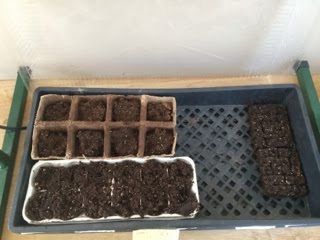
So what's going on in this picture? The past two years I've chosen to use soil blockers (which was covered in a past post). I started using a 4-block soil blocker and then I bought the mini blocker....and the blocks were so small that I was hesitant to use them. Last year I didn't use them just out of fear. This year I had the same dilemma about using them or not. I finally decided to use the mini blocker (as you can see below), but I couldn't commit 100% so I also started some seeds in peat pots and some in an old egg carton system my dad devised for me. It's a little insane to be so inconsistent, but whatever works. Next year I hope to use a more consistent system and be more confident in my choices.
Those are the soil blockers on the right. I also have a little bag of inserts that will allow the mini blocks to insert into the larger blocks once the seeds sprout (FYI - soil blockers require special soil that will hold it's shape without the use of a container). Also to the right, you can see a timer. Once I see the seedlings emerge, they'll start getting 8 - 10 hours of "sun" a day with the grow light. The timer makes sure that the light goes on in the morning and shuts off in the evening. I haven't set it up yet obviously.
Below, you'll see lettuce in the peat pots (planted a week ago so they're just starting to emerge), swiss chard and pak choi in the soil blocks, and carrots in the egg cartons (planted today). I cover the whole thing in a plastic cover for some moisture. I did not use the seed warming mat for these seeds because these seeds germinate better in temperatures between 50-70 degrees so no warming element is needed. These seeds can even be directly sowed in the spring and can tolerate a light frost, but with a foot of snow still outside and our temperatures steadily below freezing, it's too early for them, not to mention I cannot work the soil yet. I'll use the seed warming mat for heat-loving plants, like tomatoes and peppers in a week or two.
Since I have limited space under the grow light, I'm waiting for this first batch to emerge so I can start the tomatoes and peppers. These can withstand less light and lower temperatures, so they should be able to do well in a sunny window or even outside in a few weeks by day when the temperatures get a little warmer. It's all a little bit of a gamble, but I do not want the seed starting process to become too elaborate or take up too much room. This forces me to create cold frames and sheltered garden beds outside for the plants that can go outside earlier.
*Remember to always label your seeds. I make this mistake almost every year! I also try to make a note of what was planted, when, when it's expected to germinate (this way I can tell if any of the packages of seeds are duds), when it can be repotted or transplanted outside, and finally when we can expect to be harvesting it. I always have plans to make some elaborate spreadsheet, but it ends up being scribbled on a pad of paper. As long as you make a note of when you plant them and what they are, you should be OK.

